
screen-off / A practical guide
What to say when screen time ends
Write a brief screen-off sentence that states the change, acknowledges disappointment and names the next activity.
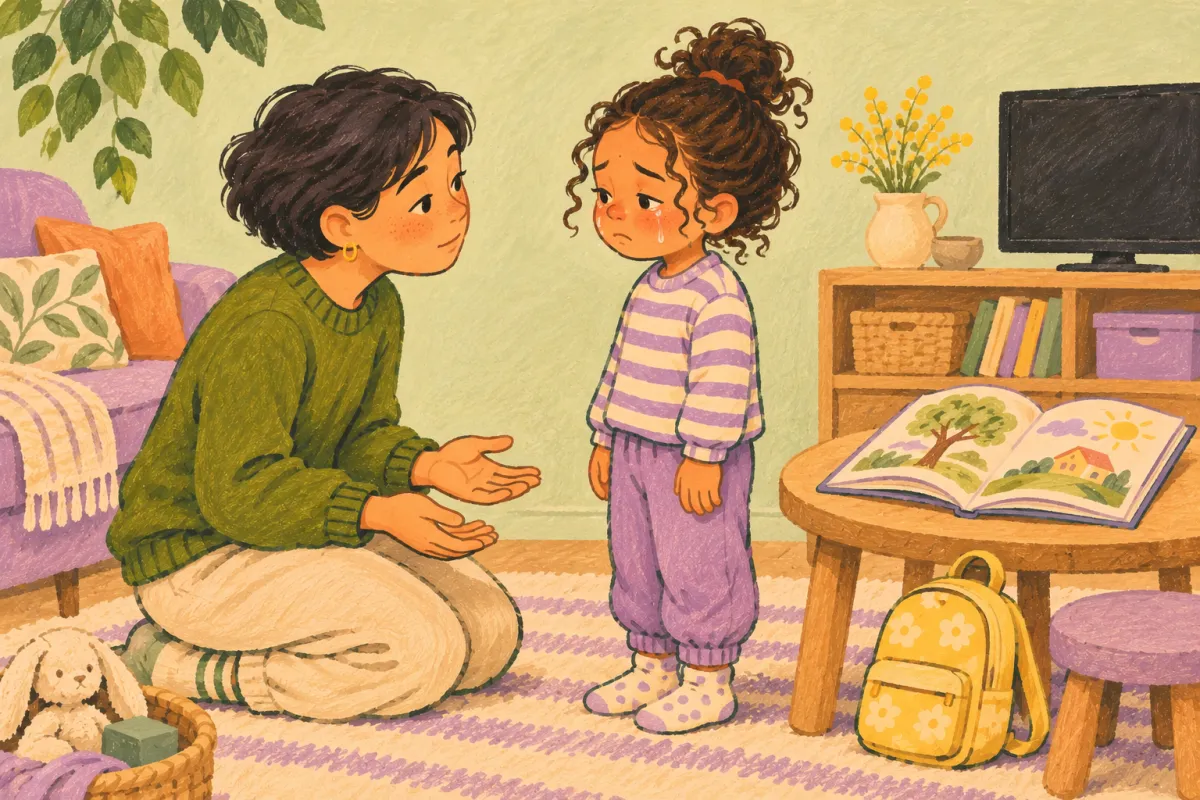
A place to start
A short script can state the change and the next step while leaving room for your child’s feelings. It is a prompt for the adult, not a technique guaranteed to stop crying.
Build your own sentence
Start with the action you are taking: “The TV is going off now.” Add a simple acknowledgment if it feels natural: “You wanted another episode.” Finish with the next step your household planned. One example is “We are going to put our book on the sofa.”
Read your sentence out loud before you need it. If it sounds like an article rather than something you would say at home, simplify it. There is no need to copy a particular tone or use special parenting vocabulary.
Make the words fit the device
For a shared TV, say what will happen for everyone watching. For a handheld device, think through where it will go and who will carry it. The words alone do not solve the handover. Keep the next physical step small and understandable.
For a younger child, showing the book or walking toward the next activity may make the plan more concrete. For an older preschooler, a small choice inside the agreed plan may fit. These are examples to adapt, not age-based promises about behavior.
Treat the script as a reminder
Share the sentence with the adult helping next time and ask what is practical for them. Agreement about the stopping point and the next activity may matter more than matching every word. Keep room to respond to comfort and safety needs.
In a check-in, separate “we used the sentence” from “the evening felt easier.” You can use a plan during a hard transition. You can also have an easy transition without using it. That distinction makes your observations more useful than a success/failure score.
Sources and limits
For broader pediatric guidance, read American Academy of Pediatrics: Screen Time & Temper Tantrums. The household examples and planning exercises on this page are our editorial suggestions; they have not been independently clinician-reviewed or tested as treatment.
CalmerTurn is an early educational product. We do not claim clinical outcomes, expert endorsement or results from families who have not used it. For persistent concerns, unusual distress, sleep or developmental worries, talk with your child’s clinician. How we write and measure →
Keep the next step connected.
A small plan for ending screen time
Plan a stopping point, prepare what comes next and share a short screen-off script with another caregiver.
Read the guide ↗
Share a screen-time plan between caregivers
Agree on a stopping point and handoff, then share the same plan without creating duplicate household records.
Read the guide ↗